
Audience effects in sport
Audience effects can be wide ranging in sport and influence a range of different key figures such as Players, Coaches and Officials. In this blog we are going to explore the theories and examples of how audience impacts sport.
The first theory we shall look at is called Home advantage which looks at 5 key distinct aspects influencing the behaviour of the 3 main figures. Home advantage is a phenomenon in the sporting world where the home side is more likely to be victorious, home advantage requires a winning percentage of above 50% (Courneya & Carron, 1992). Home advantage is stronger in some sports than others and the 5 components shown below will also be of differing importance across sports (Balmer et al., 2003).
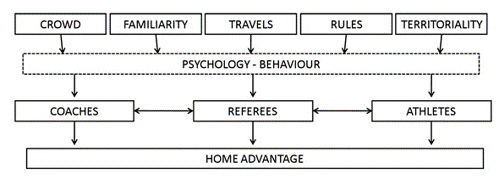
- Crowd: The self-perception of the crowd is that it has the ability to influence a result by putting pressure on officials, by trying to inspire the home team and frustrate the away team which could lead to more foul play and more benefits for the home side (Nevill et al., 2002; Wolfson et al., 2005). It links to a lot of social psychology concepts such as conformity.
- Familiarity: This is an important aspect as it means that when playing at home a player is less likely to feel as stressed. It usually refers to the understanding of the environment and surroundings. This could be pitch dimensions, the typical weather conditions e.g. where the wind blows in from, or how the altitude influences the distance of a ball being kicked.
- Travel: This can influence home advantage as having to travel further distance could mean that an away side is more fatigued and can also work in conjunction with other factors like a lack of familiarity e.g. playing in a European country for the first time. This is why preparation can have an important influence travelling up before fixtures, making sure that accommodation is suitable will all be important in mitigating the impact the travel has.
- Rules: The more subjective elements to the nature of the rules means that there is an influence that can be felt for officials, again here we can see an interaction of the different components together. The crowd can influence an official by pressuring them or responding to an event in a manner that could sway decision making so it favours a home team e.g. a poorly timed tackle. We will explore some of the reasons in more depth later on!
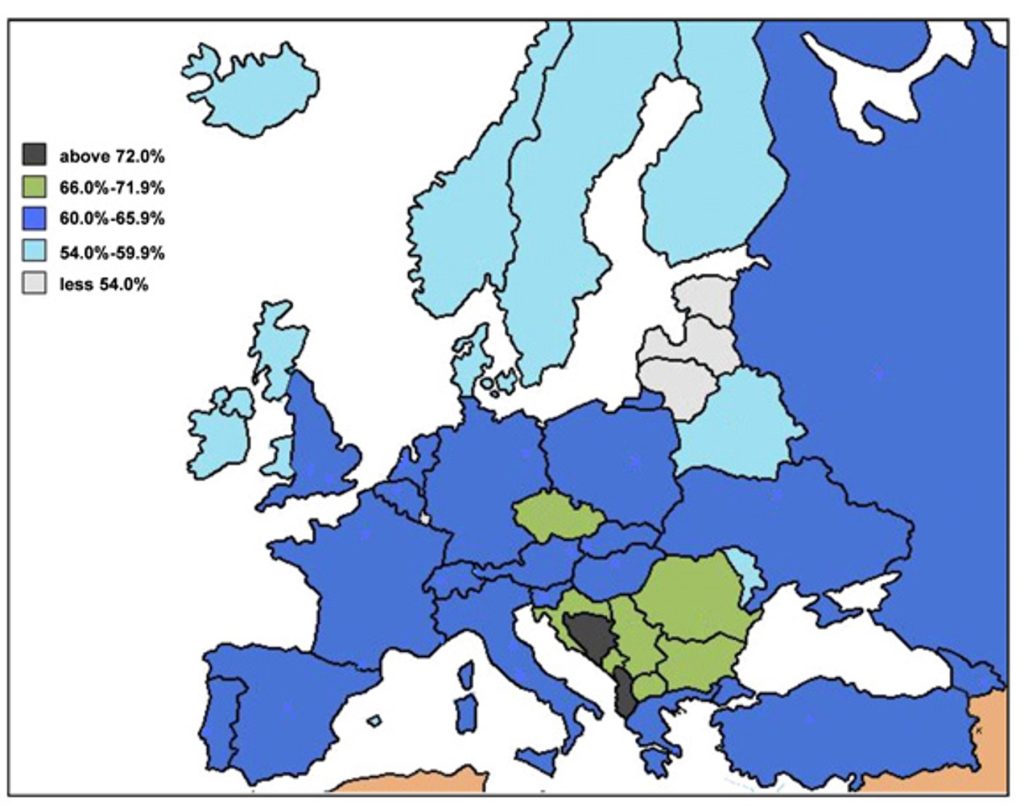
- Territoriality: Finally this factor starts to link in with branches of psychology like Evolutionary Psychology. This is where we see the interaction between the history and geography of a region influencing home advantage (Pollard, 2006). Think about England playing away at other home nations in sports like rugby in the six nations or in football Balkan countries have also been renowned for being fierce in defending territory. It doesn't need to be on a national level either, certain regions in Spain have intense pride and desire to be their own nation e.g. Catalonia or Basque regions and as a result if teams in these regions play other Spanish sides it can again interact with how the crowd operates. Testosterone has been suggested to increase when our territory is threatened so could have influence on the way the home side operates e.g. more aggression (Mazur & Booth, 1998; Neave & Wolfson, 2003).
Now that we understand this theory and 5 components we can explore more concepts that could be linked together.
Firstly, the proximity of the crowd to the playing area is suggested to to have an effect. If fans are closer to the action it's much more likely they will be heard and can have the desired impact of frustrating opponents or by influencing officials by the amount of noise they make. This is where stadium design can also have an impact, some have running tracks around them which means fans are situated further away whilst other are incredibly close and can have steep stands which means it is easier to create a hostile environment (Dohman, 2008; Buraimo, Forrest & Simmons, 2010).
Secondly we can consider the density of the crowd as this will make it feel like there is more people watching and crammed in. The noise a crowd makes will also have a key part to play in sports like American football, an away side will have to deal with a partisan crowd making loud noise to try and disrupt the flow and communication between the players and the coaches.
Impact on officials:
Conformity plays a major effect on the officials, the crowd facilitates this because the official may be looking for the following (Deutsch & Gerrard, 1955; Kelman, 1958; Mann, 1969).
• Compliance: The need for acceptance
• Information: Desire to gain more information to help decision making
• To maintain a satisfying relationship
• Normative: Avoid rejection and dissent
• Ingratiational: Motivated by social reward such as praise
Based on agent theory and the sub component of favouritism, the official is rewarded by maintaining satisfaction for the home fans and avoiding dissent (Sutter & Kocher, 2004).
Overall we do need to pick out a few issues with the home advantage theory. The ability to compare across countries is incredibly difficult for starters. The British game made drastic changes to stadiums because of a number of disasters, these changes for example include a move to all seater stadia in the higher football leagues whilst in other countries these changes were not required. As I mentioned the interaction between factors is noticeable. Separating and understanding the strength of these is almost impossible, we cant understand territory without the crowd and familiarity all playing a role (Pollard, 2008). The methodologies for understanding advantage is not always consistent; Fouls, time added, cards given (in football) may not always lead to a clear advantage for a side (Page & Page, 2010).
Audience that is supportive can add to the performance, social facilitation theory highlights that in the presence of others we will respond with an increase in arousal levels. If we have learnt skills and are able to execute skills to a high standard this audience impact will help us, if we are still learning then it is likely we are prone to make mistakes and the presence of others will not help. The dominant response is critical to this, a dominant response is the action we will typically carry out as arousal increases. Social facilitation would therefore suggest that audiences will increase performances when tasks are either easy or well learnt (Zajonc, 1965).