
Injury in sport, responses and recovery
Part and parcel of engaging in sport is the experience of injury, especially when it comes to contact sports. The experience, recovery and return to sport can be impacted by a variety of factors which we are going to explore. Watching through the sporting documentaries that are commonplace on Netflix and Amazon gives us good insight to discuss some of the psychological constructs, theories and models in action.
Risk of injury:
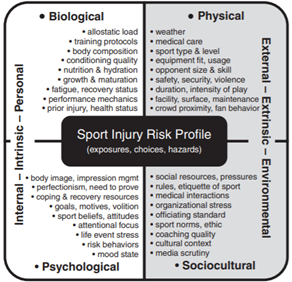
The chances of getting injured in sport can depend on multitude of factors, one framework often applied is the sport injury risk profile by Weise-Bjornstal,(2010) which utilises a biopsychosocial approach to showcase the variety of factors influencing injury. The model highlights how this variation of factors will either increase or decrease the chance of injury being suffered. The image below helps highlight this and also showcases that the factors can either be internal or external e.g. internal being prior injury whilst external being the weather.
This model therefore considers much more then just biology and can be seen the conversations and debates we are having right now in the world of sport. For example, cricket players are currently discussing how condensed the schedule is with more and more cricket being demanded, whilst in other sports like American Football they are debating the surface they play on e.g. Grass vs Astroturf and how this might influence risk of injuries like ankle or knee injuries.
Stress appraisal:
Stress plays an important role in injury and is seen to be a cause due to it’s implication in a number of different processes that can lead to injury. Williams and Andersen, (1998) summarise this nicely with their explanation being that an athlete who has more stressors, or a personality that copes worse with stress e.g. neuroticism, and finally, has less coping resources is much more likely to appraise a situation as stressful. This can impact key psychological processes during sport such as attention and lead to injury. A build up in stress can lead to cognitive worry and anxiety which means athletes might find themselves distracted, the attentional field can narrow meaning task relevant stimuli are missed, and decision making can become poorer (Hill et al., 2010). All these factors are associated with injury, think about an athlete who is distracted or is using so much of their cognitive resources that they make poorer decisions or mistakes (Ivarsson et al., 2017).
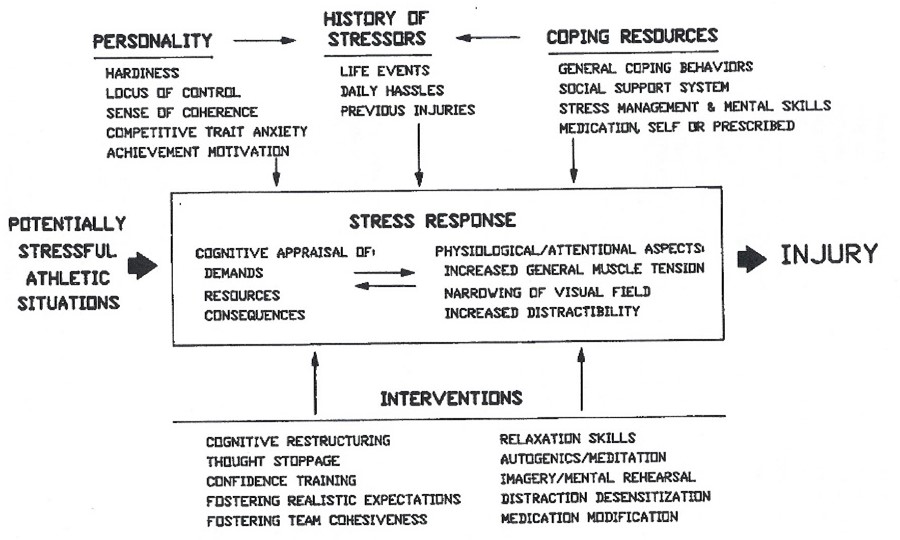
The importance of this model is that it incorporates an awareness that stress is generated from multiple places and experiences.
Reaction to injury:
Athletes will respond to their injuries in many different ways but common emptions and reactions are categorised by Evans et al., (2008).
- Devastation: feeling of shock and emptiness
- Feeling cheated: the injury is unfair and feel cheated by this
- Isolation: feeling lonely and isolated from team mates and also not wanting to be around and mix with other athletes
- Restlessness: not being able to enjoy themselves, unease and anxious
- Reorganisation: starting to build confidence in context of recovery, feeling mentally and physically stronger
Our response to injury is dictated by a multitude of factors that as coaches, medical support staff, teammates we all need to be aware of. The following image helpfully highlights just how many constructs and concepts we need to understand, naturally some of these will be more relevant to certain roles (Weise-Bjornstal et al., 1998).
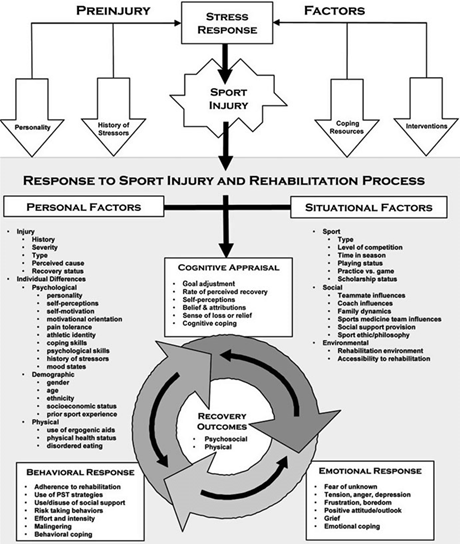
One concept associated to injury is that athletes perceive the injury experience to loss and experience grief as a result of this loss, drawing from the Kubler Ross stages of grief model (Van der Poel, & Nel, 2011). Whilst watching the receiver Netflix documentary about wide receivers in American football during episode 3, one of the medical support staff even refers to Justin Jefferson as experiencing grief because of his injury. Grief has been suggested to be an emotional response to a perceived loss, which may be characterised by behavioural and psychological manifestations (Evans & Hardy, 1995).
Now in a sport injury context the loss could be a variety of things. This could be the isolation experienced by the injured athlete, they have limited time with team-mates and coaches, again look at how Jefferson was rehabilitating by himself. At an elite level athletes may be fortunate enough to continue earning money and be under contract but others may not be so lucky and lose funding. A physical sense of loss is possible as well returning from injury the athlete may not be able to execute skills or engage in certain actions they used to pre-injury, this loss of ability can also lead to psychological challenges. Finally, loss could be more to do with self-concept and worth. The athlete has lost some aspect of their physical health, their self-esteem and potentially who they are and how they see themselves (Athletic identity).
Athletic identity:
A social construct regarding our sense of self in the athletic environment defined as “the degree to which an athlete identifies with the athlete role” (Brewer et al., 1993, p. 237). Athletic identity in context of injury is a bit of a two-sided coin in that there there’s drawbacks as well as benefits.
The drawbacks are as follows:
- Increase in sense of loss as a result of high athletic identity
- Athletic identity leads to risk of psychological distress when faced with injury or other blockages (Hayes et al., 2023)
- Loss of athletic identity as a result of the injury – Some athletes (not all)experienced a loss of athletic identity combined with feelings of not being able to help the team (Madrigal & Gill, 2014)
- Substantial decrease in athletic identity 6-12 months into ACL surgery rehabilitation most pronounced in athletes experiencing slow recovery (Brewer et al. 2010).
The positives:
- High athletic identity serves an important purpose in engaging and persevering with ACL rehabilitation (Brewer et al. 2007)
- Provides a greater reduction in negative mood during rehabilitation
- Helps to increase our emotional resilience
- Dealing with injury is part of being an athlete and they are more readily accepting of this idea.
Injury is seen as a threat to our athletic identity as it is a barrier in the way of us being able to perform. We see a reduction in this concept during injury and recovery as it helps our self-esteem and protects us from negative emotions (Brewer et al., 2010). The tricky thing we need to be aware of is the individual differences of athletes, for some athletic identity can help recovery for others it leads to more negative consequences e.g. greater feelings of loss (Madrigal & Gill, 2014).
References:
Brewer, B. W., Cornelius, A. E., Sklar, J. H., Van Raalte, J. L., Tennen, H., Armeli, S., Corsetti, J. R., & Brickner, J. C. (2007). Pain and negative mood during rehabilitation after anterior cruciate ligament reconstruction: a daily process analysis. Scandinavian journal of medicine & science in sports, 17(5), 520-529.
Brewer, B. W., Cornelius, A. E., Stephan, Y., & Van Raalte, J. (2010). Self-protective changes in athletic identity following anterior cruciate ligament reconstruction. Psychology of sport and exercise, 11(1), 1-5.
Brewer, B. W., Van Raalte, J. L., & Linder, D. E. (1993). Athletic identity: Hercules' muscles or Achilles heel?. International journal of sport psychology.
Evans, L., & Hardy, L. (1995). Sport injury and grief responses: A review. Journal of Sport and Exercise Psychology, 17(3), 227-245.
Evans, L., Hardy, L., Mitchell, I., & Rees, T. (2008). The development of a measure of psychological responses to injury. Journal of Sport Rehabilitation, 17(1), 21-37.
Hayes, C. J., Petrie, T. A., & Moore, W. G. (2023). Athletic Identity and Psychological Distress: The Moderating Roles of Social Support and Self-Compassion. Journal of Issues in Intercollegiate Athletics, 16(1), 9.
Hill, D. M., Hanton, S., Matthews, N., & Fleming, S. (2010). Choking in sport: A review. International Review of Sport and Exercise Psychology, 3(1), 24-39.
Ivarsson, A., Tranaeus, U., Johnson, U., & Stenling, A. (2017). Negative psychological responses of injury and rehabilitation adherence effects on return to play in competitive athletes: a systematic review and meta-analysis. Open access journal of sports medicine, 27-32.
Madrigal, L., & Gill, D. L. (2014). Psychological responses of Division I female athletes throughout injury recovery: A case study approach. Journal of Clinical Sport Psychology, 8(3), 276-298.
Van der Poel, J., & Nel, P. (2011). Relevance of the Kübler-Ross model to the post-injury responses of competitive athletes. South African Journal for Research in Sport, Physical Education and Recreation, 33(1), 151-164.
Wiese‐Bjornstal, D. M. (2010). Psychology and socioculture affect injury risk, response, and recovery in high‐intensity athletes: a consensus statement. Scandinavian journal of medicine & science in sports, 20, 103-111.
Wiese-Bjornstal, D. M., Smith, A. M., Shaffer, S. M., & Morrey, M. A. (1998). An integrated model of response to sport injury: Psychological and sociological dynamics. Journal of applied sport psychology, 10(1), 46-69.
Williams, J. M., & Andersen, M. B. (1998). Psychosocial antecedents of sport injury: Review and critique of the stress and injury model'. Journal of applied sport psychology, 10(1), 5-25.